Showing posts with label drawing. Show all posts

Monday, 26 March 2012

Bio-inspired storage system final : Spine Bookshelves


Compressed

Expanded

Rationale
This design is inspired from the vertebral body of human. I found human vertebral bones as a good inspiration for designing shelves. Spinal column allows you to stand upright, bend and twist. It is flexible; it allows movement in several places. It is very interesting as they are very rigid, solid and structured but at the same time it also have liquid-like properties that resulted from the S-shape of the whole structure.

The back of the shelves that holds the structure together shows a strong resemblance to the human spinal cord while the ‘leaves’ of the shelves resemble the vertebral bones. It is flat at the back as it is mounted against the wall and from the side view we can see the contours.

The shelves shows some resemblance with human vertebral body, for instance the color, which is white like bones, and the shape and the structure. The interlocking features of the shelves also inspired from the way spine body constructing and interlocking with each other, mimicking the 4 facet joints in each vertebrae body and how muscles, membranes and correct posture maintaining the structure. They are interlocking not only vertically but also horizontally, that what makes them so strong and balance eventhough it is flexible. The bottom part of the shelves shows bigger sizes in resemblance of the lumbar spine area at human spinal column for their weight bearing function.

This shelves is perfect for high density living space. It is mounted on the wall to save floor spaces and it can be dropped down when we are ready to use it. With the interlocking features in this shelves, these shelves can be compressed together and only take a very little space on your wall; in fact it only take around 51cm when it is compressed and when it is expanded it can reach about 103 cm. When you want to use it you can slide the button that connect each shelves through the maze on the 'spine' back and it is ready to used. The height of the shelves also adjustable so it meets many needs.

Technical drawings

Tuesday, 6 March 2012

Bio-inspired storage concepts

Concept 1 – Bookshelf inspired by human vertebral body


This concept is inspired from the vertebral body of human. I found human vertebral bones very interesting as they are very rigid, solid and structured but at the same time it also have liquid-like properties that possibly resulted from the S-shape of the whole structure. 


The core of the shelves that holds the structure together (the tall cylinder in the middle) shows a strong resemblance to the human spinal cord while the ‘leaves’ of the shelves resemble the vertebral bones. It is flat at the back as it is placed against the wall and from the side view we can see that the shelf have contours that is almost shaped like number ‘3’ or ‘S’ (rising at the top, then goes thinner in the middle and then goes bigger to the end). 

The shelf is designed to store books as it is placed against the wall but it is not necessarily limited to books, it may extend to other objects. But despite of the physical function of this shelf, the other aim of this concept is to evoke emotions to the users, to have the same feeling we have when we see human bone structures; the feeling of strength and power.


Concept 2 – Shelves inspired by termite’s nest


For this concept I got the inspiration from the complex structure of termite’s nest. The nest consists of many horizontal layers which are connected by spiral staircases. Termite’s nests are punctuated by a maze of tunnel-like galleries that effectively provide air conditioning as well as allow the termites to move through the nest. There are several entrance to their nest and they are well protected. 


Like the actual nest, this shelves consist of many horizontal layers that are stacked together, creating space to store objects from books, DVDs, or it can be used to store shoes and sandals as well. Mimicking the spiral staircases of termite’s nest, the structure of this shelves are well supported by stacks of layers (possibly using MDF sheet) that support each other balance.

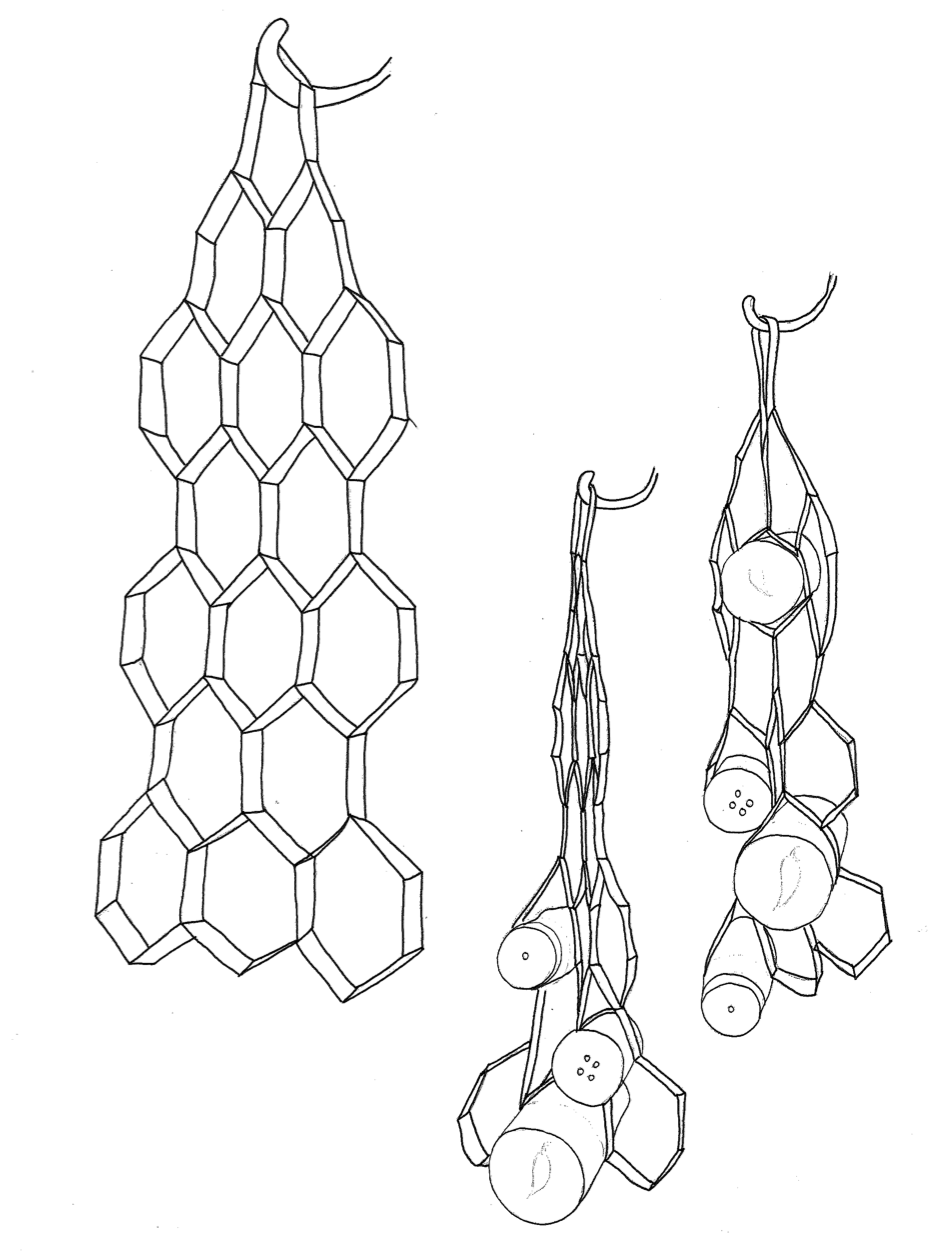
Concept 3 – Spice rack inspired by honeycomb


Honeycomb has been an inspiration in many design process, I believe because a hexagonal structure uses the least material to create a lattice of cells within a given volume. What I’m trying is to apply this geometric efficiency as a solution in designing storage for small spaces. 


This spice rack is made from fabric or some kind of material that is elastic (I’m still keeping my options open). It can be flat-packed when it’s not used and while we are using it, it only needs to be hooked. It also has the flexibility to store more or less as required.


Which one is your fave?
Feedbacks are welcome!

ciao!

Tuesday, 13 September 2011

Project 1 Studio 2011 - Mortar & Pestle


Rationale
Besides its unusual shape and the way this mortar and pestle assembled, the main thing that distinguishes this product from the one in the market is the expanding shape of the pestle towards the lid. Not only it has a fitting diameter handle for our handgrip, this shape also prevent our hand slipping over the pestle and at the same time it reduces the power needed to hold the pestle tightly while using it. Furthermore, the concave interior of the mortar aims to avoid the objects being spilled out during pounding and grinding.

I actually put a lot of time sketching and making mock ups to get the best size and shape of these tools. The main difficulty is to make the size of the mortar and the pestle in balance but not to put aside the overall look as they are also stand as one piece. The size and shape of the mortar will affect the size and the shape of the pestle and vice versa. Finally I arrive at this size where the mortar is not as small as the one used in medical place and not as big as the one in the market (those big stone and granite mortar) but big enough to make sauce or paste.

Another main feature of this tool is its material, which is stainless steel. The reason why I choose stainless steel over other material is because it has some technical properties that offer some benefits such as;
  • Strong and long lasting 
  • Better than stone because it is cohesive and corrosion resistance; small bits of the mortar and pestle won’t get mixed with the objects 
  • Better than wood because it is not absorbent and non-porous; won’t absorb/ trap the ingredients being ground and prevent the growth of microorganisms from the food particles that are left in the mortar and pestle surface
  • Non-reactive with alkaline or acidic foods so it is safe either for food preparation or medical use
  • Easy to clean; dishwasher safe


Technical Drawings in A1 (Click the image to get better resolution)
Feedbacks are more than welcomed :)

Friday, 29 July 2011

Project1 Trials - Mortar and Pestle

This is my new design concepts for project one.. The tools i chose to redesign is mortar and pestle. Here is the rough sketch and some notes explaining it's design.

(Click the image to get better resolutions)

In this concept my focus was more on its aesthetics, even though ergonomic and other important things are also considered. I was imagining how it's gonna stand in the kitchen. When it is not used (the pestle isnt turned over), it will stand on the kitchen shelf more likely as a sculpture. It's not like the way a normal mortar-and-pestle looks like.


P.S. If you can't read my yucky handwriting (so sorry!), don't hesitate to ask :)
Feedback would be awesome :D

ciao!

Tuesday, 28 June 2011

Camouflage


Emma Hack is what is known as a ‘body artist’; meaning her canvas of choice is the human body. Using wallpapers, Hack painted models to match, making them literally disappear into the wall.

Enjoy (:


Wallpaper Cat

Tawny Frogmouth

Crocodile Skin

Wedge Tailed Eagle in Paisley

Owl in Woods

Fans


Balllerina

Egrets Mandala

Peony with Butterflies

Tropical Palm with Butterflies

Oriental Blossom with Butterflies

Peacock with Butterflies

Chrysanthemum with Butterflies

Ming Baluster Vase

Ming Bottle Vase

Evolution - Turtles

Baby Owl in Pine Needles

Echidna in Banksia

Goanna in Sturt Desert Rose

Joey in Kangaroo Paw

Kookaburra in Feather Wheel

Southern Hairy-Nose
 ciao!

Friday, 3 June 2011

Islamic Patterns

Assignment for IDES1161 Industrial Design UNSW. Feedbacks are welcomed (:

Black ink on A2 tracing paper with pencil construction lines

ciao!

Wednesday, 4 May 2011

Pencil vs Camera

Check out this amazing artist, it's Ben Heine everybody!


This is definitely my favourite <3

See the whole "Pencil vs Camera" album at http://benjaminheine.blogspot.com

ciao!